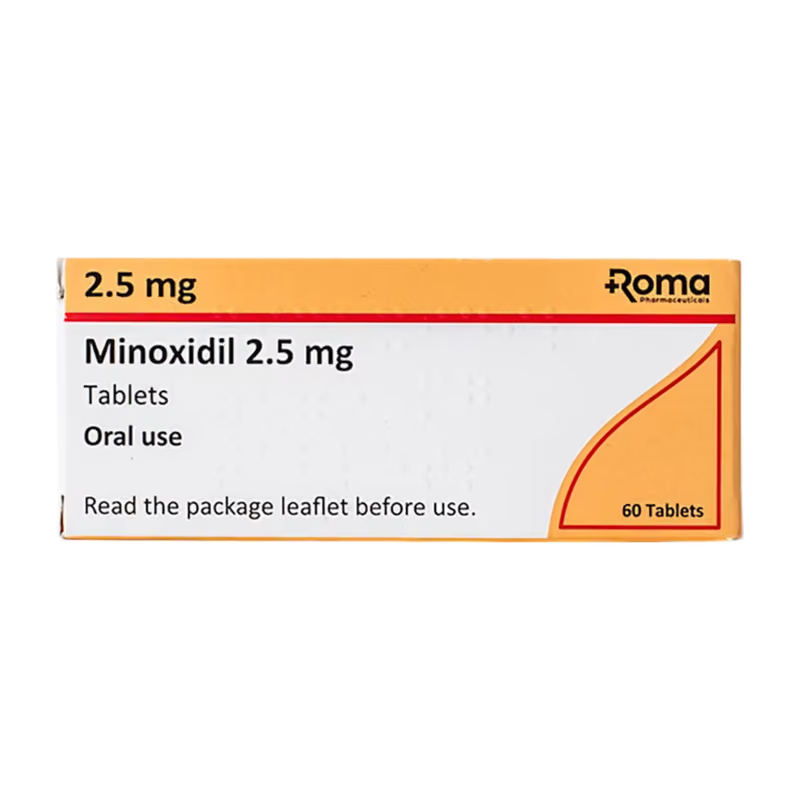
oral minoxidil at a glance
| What it is | Minoxidil tablets, taken by mouth at a low dose |
|---|---|
| Used for | Female pattern hair loss (androgenetic alopecia) |
| Prescription | Prescription only. A clinician decides whether it's right for you |
| Licence | Licensed in the UK for severe high blood pressure. Used off-label for hair loss |
| Usual dose for women | Usually 0.5 to 0.625 mg a day to start, or 0.625 mg (a quarter of a tablet) every other day, up to 2.5 mg a day |
| How long before you can judge it | Up to 6 months |
| Not suitable | In pregnancy, while trying to get pregnant or breastfeeding, and for some heart conditions |
| Price | £44.99 for 60 × 2.5 mg tablets, with free delivery, if a clinician prescribes it |
| How long a pack lasts | About 8 months of treatment at the usual starting dose (a quarter of a tablet, 0.625 mg, a day) |
what oral minoxidil is
Minoxidil was first made as a tablet for high blood pressure. Doctors noticed it made hair grow, which led to the foam and solution you put on your scalp. Today, minoxidil tablets (sometimes called minoxidil pills) are still licensed in the UK only for severe high blood pressure, at much higher doses than are used for hair loss.1
At a low dose, oral minoxidil is prescribed off-label for female pattern hair loss, whose medical name is androgenetic alopecia. Off-label means a medicine is used for something other than what its licence covers. A clinician will only prescribe it if they judge it's right for you.
Minoxidil isn't a hormone treatment. Like the scalp version, it only works for as long as you take it. Our guide to minoxidil for women compares the two forms.
In female pattern hair loss, many follicles shrink over time. They grow shorter, finer hairs, so more scalp shows through.
Minoxidil nudges resting hairs into a new growing phase, so old hairs are pushed out early. This is the extra shedding many women notice a few weeks in. It usually settles.
New hairs keep growing, and for some women the thinning slows or some hair grows back. It can take up to 6 months to tell whether it's working, and not everyone responds.
Minoxidil only works while you take it. If you stop, any benefit gradually fades and the follicles go back to how they were.
- growing hair
- miniaturised hair
- resting hair
- shedding hair, new one starting
- new hair
Nobody knows exactly how minoxidil works on hair. It's thought to move resting hairs into a new growing phase, with old hairs falling out as new ones grow in their place. That shift is why many women shed more for a few weeks at first.2,5 Female pattern hair loss shrinks the follicles over time,4 and the benefit lasts only while you take it.3
who it may suit
A clinician may consider oral minoxidil if you have female pattern hair loss and:
- you'd rather take a tablet than apply a foam or solution every day
- topical minoxidil has irritated your scalp, or hasn't suited you
- you're ready to take a treatment long term, knowing the benefit lasts only while you take it
It isn't the right treatment if your hair loss has another cause. Shedding after an illness, a birth or a stressful time often settles on its own, and low iron or a thyroid problem needs treating first.6 If you're not sure what's causing your hair loss, our telogen effluvium vs female pattern hair loss guide can help.
Oral minoxidil isn't suitable for everyone. You can't take it if you're pregnant, trying to get pregnant or breastfeeding,1,3 and it isn't usually advised with some heart and kidney conditions or if you already take medicine to lower your blood pressure.2,3 The full list is in who shouldn't take oral minoxidil, further down this page.
how it's taken
Oral minoxidil for hair loss is taken once a day, at a much lower dose than for blood pressure. Women usually start on 0.5 to 0.625 mg a day, or 0.625 mg every other day. 0.625 mg is a quarter of a 2.5 mg tablet. If needed, the dose is increased slowly, up to 2.5 mg a day.2,3
Because the tablet is 2.5 mg, you'll cut it into quarters,3 using a pill cutter rather than a knife. At a quarter of a tablet a day, a pack of 60 tablets lasts about 8 months, and longer if you take it every other day. Your clinician will tell you exactly how much to take, and any changes to your dose are made with them.
what to expect month by month
first days and weeks
getting used to it
Side effects such as a faster heartbeat or feeling lightheaded, if they happen, usually show up early, often in the first few days or the first week.
weeks 2 to 10
possible extra shedding
Many women shed more hair, usually starting 2 to 4 weeks in and lasting 3 to 6 weeks. It's expected and usually settles.
months 1 to 3
watching for swelling
Fluid retention, such as swollen ankles, tends to show up after 1 to 3 months if it's going to. Tell your clinician if it does.
around 6 months
time to judge it
It can take up to 6 months to work. Comparing monthly photos of your parting is the fairest way to see whether it's helping.
after that
keep going to keep it
Minoxidil only works for as long as you take it, so treatment is long term.
Timings come from a 2025 review of the published studies2 and an NHS dermatology leaflet.3 Not everyone responds to treatment. Our guide to does minoxidil work looks at the evidence and how to tell whether it's working.
take today's photo. you'll want it later
Nobody can see hair loss happening. By the time a parting looks wider in the mirror, it’s been widening for months. The only way to know what your hair is actually doing is to photograph it now and look again later.
two photos, two minutes
1. your parting
Hold your phone above your head, camera pointing down, and photograph the parting you normally wear.
2. your ponytail
Pull it over one shoulder and photograph it against the front of your top, so the thickness is clear.
Do it just after washing and drying, before styling. Save them somewhere you’ll find them again.
what you’ll be able to see
- if you’re shedding, whether it’s slowing and growing back
- if you’re thinning, whether the parting is holding or widening
- if you’re starting treatment, here or anywhere else, whether it’s working
side effects and checks
Most women who take low-dose oral minoxidil have no side effects or only mild ones. In studies:2
- unwanted hair on the face or body affected about 15 in 100 people, more often in women and at higher doses, and rarely led to stopping
- fluid retention, such as swollen ankles, affected about 1 to 10 in 100
- a fast heartbeat or palpitations affected about 1 to 4 in 100
- dizziness or lightheadedness affected about 1 to 2 in 100
- headaches affected up to about 9 in 100, usually starting 2 to 3 weeks in, and can occasionally mean adjusting the dose
Because alcohol also lowers blood pressure, it's sensible to cut down.3 While you take it, it's sensible to have your blood pressure and pulse checked by your GP from time to time.3 For the full picture, read our guide to minoxidil side effects.
how to get oral minoxidil in the UK
Oral minoxidil is prescription only in the UK, so you can't buy minoxidil tablets over the counter. Some NHS dermatology departments prescribe it,3 and so do online pharmacies with their own clinicians, always after a consultation. Be wary of any website that will send minoxidil tablets without asking about your health and your blood pressure first.
Through this site, you have a consultation with The Independent Pharmacy, a pharmacy registered with the GPhC. Our guide to the female hair loss consultation explains what it involves.
- You complete a short online consultation with our partner pharmacy, answering questions about your hair, your health and the medicines you take.
- A clinician reviews it and decides whether oral minoxidil is right for you. They may ask you more questions, suggest something else, or advise you to see your GP.
- If it's prescribed, our partner pharmacy dispenses it and sends it to you, with instructions on your dose.
Going straight to the consultation skips our own assessment, so our partner pharmacy runs its own eligibility checks. If you're not sure what's causing your hair loss, take our free assessment first.